I first did
hitta-gake (tie-dye effect) on
Suehiro and really liked it, although I thought my first attempt was heavy handed. A tutor advised me that I should use a more tightly twisted thread. I would say that
Shizuka Kusano also has a fondness for this novel effect as it is a recurring theme in her book "The Fine Art of Kimono Embroidery".
At first, I did not fully appreciate why this design is called tie-dye effect but recently I have become interested in
shibori and now I can see what this novel effect represents.
This article by
John Marshall explains how
kanokoshibori is made and the meaning of its name.
Like all the novel effects that I have worked so far, hitta-gake starts with a foundation, this one is a weft foundation worked in flat silk (white). A grid of threads is then laid diagonally over the foundation. The threads are space 5mm apart and this time I remembered the advise I was given and twisted the thread tightly.

© Jennifer Ashley Taylor/Carol-Anne Conway
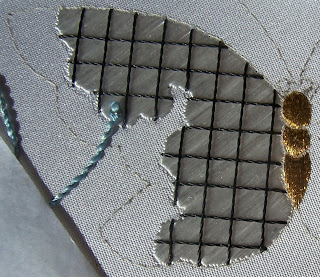
© Jennifer Ashley Taylor/Carol-Anne Conway
Where the laid threads intersect, they are tied down with three short stitches in the same twisted thread.

© Jennifer Ashley Taylor/Carol-Anne Conway
Finally, in the center of each square, two short stitches are worked over a sleeper stitch, still using the same twisted thread.

© Jennifer Ashley Taylor/Carol-Anne Conway
This time, I think I have achieved the lighter touch that I was aiming for, but I do not think that the foundation is as good as on
Suehiro, that may be because I worked this foundation in a single strand of flat silk, but on
Suehiro I used 1.5 or 2 strands. The threads that I am using for
Flutterbys is naturally thicker than those I used for
Suehiro so I thought that 1 strand would be sufficient. Even so, I am satisfied with this
hitta-gake.
Happy Stitching


