Showing posts with label Japan Trip. Show all posts

Sunday, 13 December 2015

a memory stirs within

We have a book club at work and through that I have read some very enjoyable novels, the latest of which was "Bodies of Light" by Sarah Moss.

"Bodies of light" tells the tale of Ally and her battle to gain her mother’s affection and approval while striving to become one of the first female doctors in England. I enjoyed this book so much that I immediately started to read the sequel "Signs for Lost Children". This book continues the story of Ally and her new husband Tom Cavendish. It would have been enough for me to follow the progress of Ally, Doctor Moberley-Cavendish, but, as she plunges into the institutional politics of mental health, Tom travels to Japan to build lighthouses. I found the chapters that explore Tom’s experiences in late 19th century Japan totally captivating. I was easily able to imagine him in Kyoto as the descriptions of the streets and building so clearly matched my own memories of when I was there.

Tom is appointed to procure Japanese antiquities and artefacts during his stay in Japan and this quest takes him to the textile producers of Kyoto. The passages about his visits to the weavers, dyers, and embroiderers are all too brief and tantalizing but still ridiculously thrilling for someone interested in Japanese textiles. But this book had one more, exquisite surprise for me.

In the chapter entitled "hortus conclusus" Tom is taken to an exhibition in one of Kyoto’s Palaces. At first Tom thinks there is nothing different from the dozen such things he has acquired for his patron.
"And then he sees the cranes, first as five white shapes glowing like moons in the dim and filtered daylight. He approaches and finds himself before some kind of painting or drawing of five long-legged birds wading under overhanging wisterias. …"
A memory stirs within me of standing before a screen, a scene depicting five long legged birds wading under overhanging wisterias …
"He has seen flowers like that, dripping the full height of the trees in a mountain forest, and he has seen cranes bowing and dipping, their white wings raised like the arms of the dancer about to begin. …"
I have seen flowers like that, cranes like that, not real flowers nor real cranes but their image …
"The five cranes are sociable, like a Japanese family preening and teasing in the bath. One is drawn up to its full height to peer down at the others busy at their toilette, and another leans in, neck outstretched so that the black markings on its silver plumage draw Tom’s gaze across the darkness at the picture’s centre and towards the arched breasts and glossy wings of its companions. Behind them, the wisteria blossoms fall like streams of water and it’s not paint, he realises, but silk, the filament of each feather drawn in stitches smaller than a mouse’s hair."
By now (1.12 am in the morning) I was so convinced that I had seen this very panel at the "Threads of Silk and Gold" exhibition at the Ashmolean Museum that I had to fetch my copy of the book of the same name and flick through its pages until on page 116 I found the image I was looking for, "Cranes, wisteria and cycads".

"Cranes, wisteria and cycads"
© The Ashmolean Museum

"Cranes, wisteria and cycads", detail
© The Ashmolean Museum

As this exhibition was in a museum in my home town, I was privileged to visit it many times and to explore the embroideries through my own eyes and those of my knowledgeable friends. It was a delight to me to see it again through the eyes or Tom Cavendish or, perhaps more realistically, through the eyes of Sarah Moss. From her biography, I discovered that Sarah Moss studied in Oxford. It is not beyond the realms of my imagination that on a return visit to Oxford she visited the "Threads of Silk and Gold" exhibition. Perhaps we stood side by side, mesmerised by the beauty of the silk and the skill of the stitchers. Certainly her writing has transported me back to that exhibition and to my trip to Japan in the following spring – memories I am happy to revisit any day and a journey I would gladly make again.

Happy Stitching

Thursday, 12 February 2015

Speaking of boxes

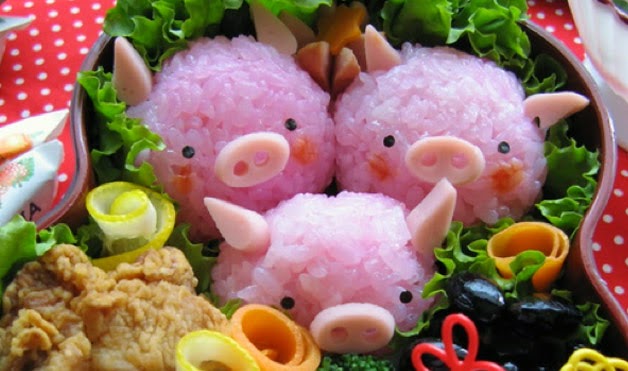
Bento is the Japanese version of a packed lunch. They usually contain a selection of rice, fish or meat, and pickled and/or cooked vegetables. Commercial bento boxes are readily available at convenience stores, bento shops and at railway stations. We made several long rail journeys while in Japan and usually purchased a bento box for our lunch. I enjoyed everything about them, the beautiful packaging, the ornate tooth picks and most especially the food (I absolutely loved the food in Japan!).

© B2C

Bento can also be homemade with the maker often taking time and care to arrange the contents in elaborate styles. Rice balls are sometimes decorated to resemble animals or popular characters from cartoons or comic books.


The boxes that contain the bento are as important as the contents. They are available in a dazzling variety of styles and even the ‘plain’ ones come in beautiful colours. Again cartoon characters are popular images on bento boxes as are traditional wood block pictures. Other boxes might be shaped to resemble something, such as houses, books or kokeshi dolls.


Not all bento boxes are mass produced and some of them are exquisite works of art.

I found this one at an antiques fair in Japan. We spent a morning there where Denise and I soon noticed, and then started actively searching for, the beautifully decorated boxes. Not all were bento boxes, in fact most of the boxes that caught our eye were writing boxes.

© Carol-Anne Conway

I can’t imagine putting my lunch my bento box. I did envisage using it as a ‘current JE project’ sewing box but I have not been able to bring myself even to do that. It sits on the top a book case in my sewing room and is the first thing I see when I enter the room.

© Carol-Anne Conway

Happy Stitching

Tuesday, 10 February 2015

Travelling Sewing Kit

Sanjo-Honke Misuyabari also sold a range of sewing boxes made of kiri or paulownia wood. Kiri wood is thought to be ideal for sewing boxes as they can be closed tightly which keeps needles from rusting. The boxes came in many sizes but I choose the dinkiest box they stocked. This darling travel sewing kit. The lid fits so precisely that the lettering on the front is stamped across the box and the lid to show the correct alignment when replacing the lib. The small characters on the right appear to be 三條本家 みすや針 (Sanjo-Honke Misuyabari). I would love to know what the characters on the left say.

© Carol-Anne Conway

The accessories fit very snugly inside their box and are all made of the same fabric. There were many different fabrics and colours to choose between.

© Carol-Anne Conway

In the lid is a pin cushion and the box contains three spools of thread, a pain of mini snips and a packet of needles.

© Carol-Anne Conway

© Carol-Anne Conway

I have not used this yet but now I am reminded of how lovely it is, from now on this will accompany me on my travels.

© Carol-Anne Conway

Happy Stitching

Monday, 9 February 2015

Needles and Pins

So, would you like to see what I bought in Sanjo-Honke Misuyabari?

© Carol-Anne Conway

It may not look like much but to me it is a precious haul. The first thing on my shopping list was some handmade Japanese needles. The needles are so precious that each one is individually wrapped. The proprietor wrote the needle sizes on the front of each packet.

© Carol-Anne Conway

And on the reverse he wrote their names.

© Carol-Anne Conway

Inside each paper packet the needles are kept safe within a little foil package.

© Carol-Anne Conway

And here they are, my beautiful hand made needles purchased in Japan, from left to right oo-buto (#10), ai-chuu (#8) and kiritsuke (#5).

© Carol-Anne Conway

The needles purchase from the fishing shop were slightly less lovingly packaged. I imagine that the outer wrapper gives the name of the shop as well as the telephone and fax numbers. The needles were wrapped in a second piece of paper something like gress proof paper.

© Carol-Anne Conway

Inside that the needles are threaded into a piece of the same paper. I have no record of their sizes and cannot remember exactly what they are but I believe that they are #11, #9 and #7.

© Carol-Anne Conway

And here, for comparison, are a some of my JEC needles (far left), the Misuyabari needles and the fishing shop needles. We are told that there is only one needle maker left in Japan. The JEC and Misuyabari are so a like that they are most likely to be from the same manufacturer but the fishing shop needles are distinctly different and I suspect that they come from a different manufacture. They do not appear to be of the same quality. I have not used either the Misuyabari nor the fishing shop needles yet.

© Carol-Anne Conway

I also purchased this pack of pins. They are not hand made but these are useful when beading.

© Carol-Anne Conway

The other item on my shopping list was a tekobari. I already have two but again but, hey!

© Carol-Anne Conway

Happy stitching

Sunday, 8 February 2015

A Needle in a Market

A couple of years ago I was lucky enough to visit Japan with a group of Japanese embroidery friends and my lovely hubby. The despoke tour was arranged for us by Gill Clay who also served as our tour guide while we were there. As well as a few of the countries' vast array of cultural and historic delights, our tour was taylored to our interest in textiles and included visits to some places that we had specificly requested. We had a very full intinary.

© Carol-Anne Conway

We were based in Kyoto and many of our visits were based in and around this ancient city. One such trip was to the Nishiki Market. The oldest, and most famed, part of the market is a long narrow shopping 'street' that specializes in food and is a great place to explore some of Japan's culinary delights. This lively part of the indoor market is what Gill had taken us to see but we knew that beyond "Kyoto's Kitchen", within a part of the market that had been modernised, and whose shops were more akin to western shopping centres, lie hidden a glimpse into yesteryear and an absolute gem as far as we were concerned. When Gill let us of the leash to expore the market for a couple of hours, a few of us set of to find Sanjo-Honke Misuyabari - the needle shop.

© Carol-Anne Conway

One of our group, Dee, had learnt of the needle shop from a post on the blog JustHungry. This post provided a good description of how to find the Misuyabari shop but, unfortunately, we had neglected to take this information with us on the day we visited the market, we had to rely on our memory of the blog and our inginuity to reach our goal. We searched for some time and were on the point of giving up when a flash of inspiration from Maggie lead us to the prize. We knew that we were in the vicinity and Maggie had spotted a shop selling traditional knives; she asked them where we would find the needle shop and they furnished us with directions. As it turned out we were standing virtually next to the small and inconspicusious allay way that lead to a small Japanese garden and there, in this oasis of tranquility, was the even smaller traditional store that is Misuyabar.

© Carol-Anne Conway

© Carol-Anne Conway

The shop is tiny, consisting of one counter and some shelves along one wall, but the contents of the shop are enough to make the heart of any needle(wo)man race. Needles - hundreds of needles beautifully arranged in the glass counter - and pins - exquisit little pins - and gorgeous wooden sewing kits. Everything a needle(wo)man could desire. Had we had the resources, I think that we would have purchased the entire contents of the shop. However, we could not initially see the items for which we had made this pilgrimage - hand-made embroidery needles. Luckily, Denise had come prepared with some sample needles and when she showed these to the gentlemen behing the counter they reached below the glass cabinet to retrieve the tray containing our quarry.

© Carol-Anne Conway

When we went our seperate ways, we had agreed a time and place to rejoin Gill and the rest of the group and we were aware that our time was rapidly running out but this was an experience not to be rushed. And besides, the gentlemen were not to be rushed; each item that we purchased was lovingly wrapped and labelled for future identification. I should perhaps mention that the gentlemen spoke no English and we speak no Japanese so the entire transation took place through a series of jestures, hand signals, smiles and squeels of delights.

© Carol-Anne Conway

I find it hard to express how much I enjoyed my holiday in Japan - every moment was a highlight - but this little excursion to Sanjo-Honke Misuyabari is one of my most treasured memories.

Here is a link to the post on JustHungry that describes how to reach the shop and has some lovely pictures. Here is a link to another blog post that describes their visit to the shop and has more lovely pictures. Happy Harikuyo

p.s. We had a second, unplanned, needle adventure in Japan. We visited an embroidery house in Kanazawa where a few of us took part in an embroidery workshop. I'm not entirely sure how it came about but the proprietors of the embroidery house arranged taxis to take us to their needle suppliers who were closed that day but agreed to open there store especially for us. When we arrived, we were a bit perplexed to find ourselves at a fishing tackle shop but, sure enough, they did stock hand-made Japanese needles in a range of sizes and were more than happy to sell us some. As at Misuyabari, the proprietors spoke no English (or so we thought, wait for it) so the transaction was conducted through the now familiar jestures and smiles. When we left the store and climbed back into the waiting taxis one of the gentlemen ran after us calling "Where from? Where from?" "England" we called back as we waved good bye. I had visions of them in the local sake bar that evening telling their friends "You'll never guess what happened today - a group of English ladies came into the shop and bought our entire stock of needles". And I can hear their friends saying back "Ha! You and your fisherman's tales!".